Beyond the AI Translational Gap: Can Foundation Models Finally Bridge Research and Practice in Pediatrics?
July 2026
Abstract
Background: Artificial intelligence (AI) is rapidly advancing, yet a persistent gap separates strong retrospective model performance from measurable clinical benefit – the "AI chasm." This gap is wider in Pediatrics where physiology varies with maturational stage, datasets are small and fragmented, and the field is underfunded relative to adult medicine. Foundation models (FMs), pretrained and then adapted, have been proposed as a solution to this problem. We examine whether that promise holds for children.
Methods: This narrative review is organized around research questions that span FM capabilities, pediatric evidence by data modality, AI safety, and the conditions for clinical adoption. We combined agentic and semantic literature search across PubMed, arXiv, medRxiv, and Semantic Scholar with manual search of high-impact venues and screening of reference lists. Pediatric patients were defined as 0 to under 18 years. Every included study was verified against its primary source, and each claim was rechecked against the original text.
Results: FM capabilities are real, but the convincing demonstrations come from adult medicine – medical question answering, multimodal generalists, and subspecialty specific FMs including adult cardiology and oncology. To the best of our knowledge, no pediatric FM system that directly informs diagnosis or treatment has undergone clinical validation and reached clinical deployment. Pediatrics continues to be characterized by task-specific deep learning. Diagnostic models remain at the retrospective-benchmark stage, and pediatric-native FMs are typically unpublished preprints confined to one or two centers. Major factors hindering clinical deployment include model overconfidence and miscalibration, limited explainability, absence of validation frameworks, regulatory uncertainty, safety risks, and ethical concerns specific to pediatrics.
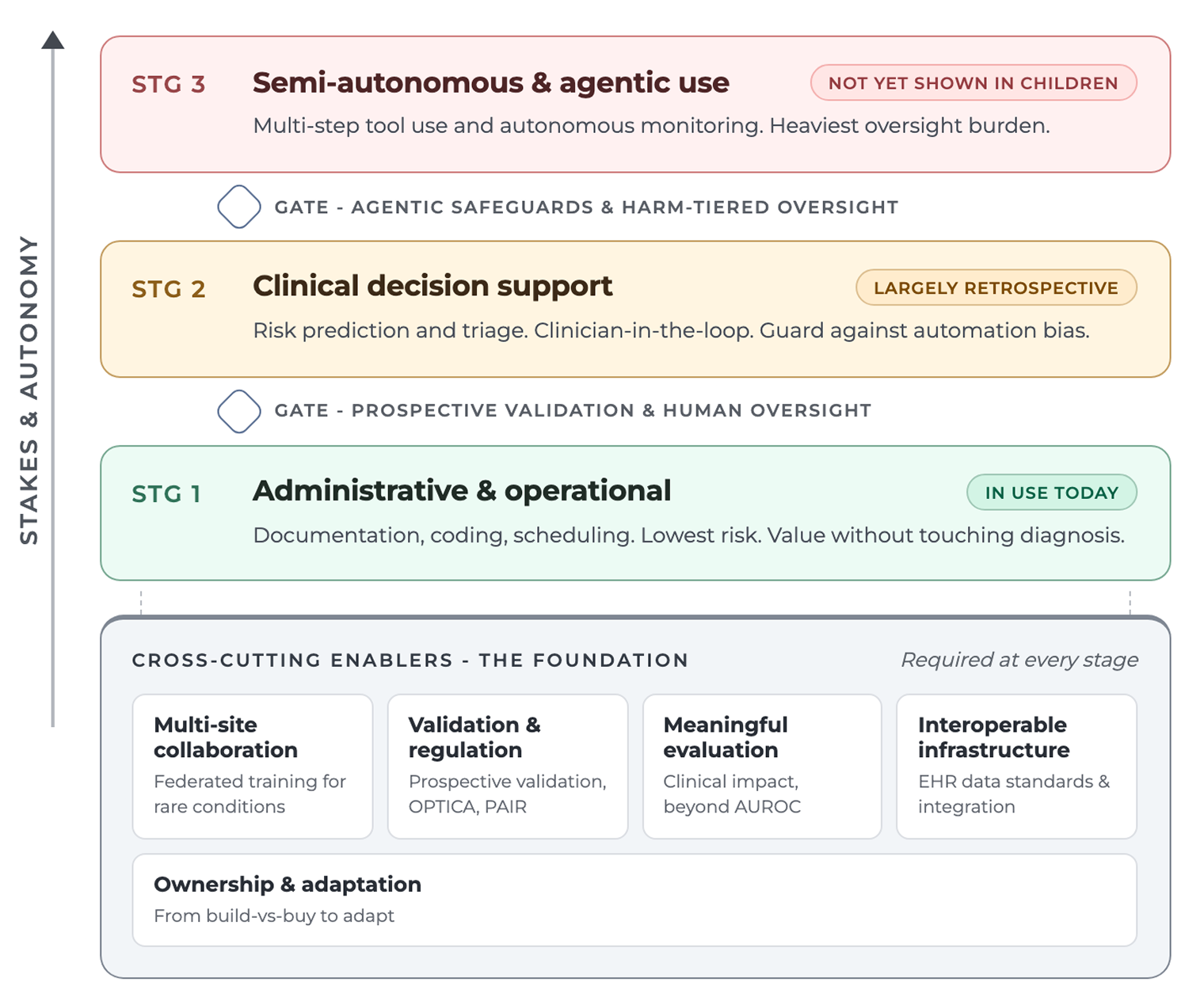
Conclusions: Foundation models hold genuine promise for closing the translational gap in pediatrics. Successful deployment requires development of regulatory, research, and deployment mechanisms within a hospital system combined with prospective validation, interpretability, and safety oversight.